Community Solar Grids
How neighborhood trusts and rural municipalities are building resilient, islandable 48V direct-current power architectures that bypass corporate grid congestion fees.
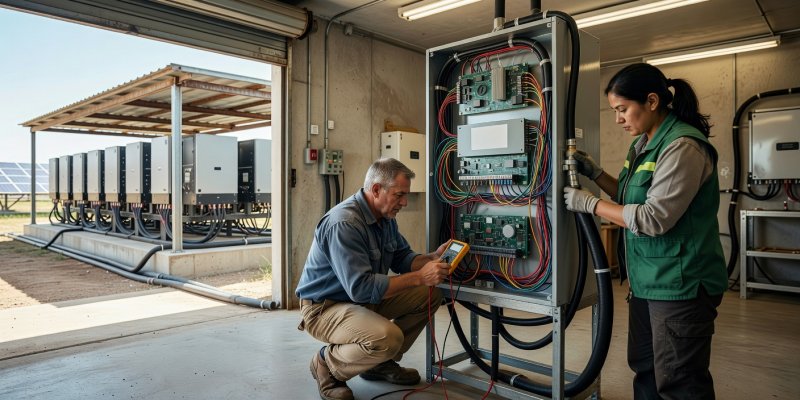
Centralized national utility grids were conceived around high-voltage transmission lines carrying power from massive centralized generation facilities to passive suburban consumers. In an age of dispersed solar generation and heat pump electrification, this top-down architecture produces severe transmission bottlenecks, line losses, and artificial curtailment of green energy. Community solar grids invert this logic: power is produced, stored, and managed locally within a shared neighborhood perimeter.
1. The 48-Volt Direct Current Neighborhood Bus
Traditional alternating current (AC) domestic setups undergo multiple inefficient inversion cycles: solar photovoltaic cells generate DC, which is inverted to AC by rooftop modules, only to be converted back into DC inside domestic heat pump drivers, laptop chargers, LED drivers, and battery packs. Each inversion step incurs a four to eight percent thermodynamic efficiency penalty.
Innovative municipal microgrids in the Scottish Highlands and northern Spain implement a localized 48V DC community spine. By transmitting low-voltage DC directly between neighboring storage packs and high-draw refrigeration units, overall round-trip transmission efficiency rises above 92 percent, while eliminating the electrocution hazards inherent to high-voltage AC domestic hookups.
2. Second-Life Battery Diagnostics and Assembly
One of the largest misconceptions surrounding renewable storage is that lithium battery cells must be brand new. Electric vehicle battery packs are typically retired when their total retention falls to 75-80 percent of initial capacity—a condition unsuited for high-acceleration road driving, yet fully functional for stationary energy reserves.
Community energy collectives recover these decommissioned packs using open hardware cyclers that test individual internal resistance and cell capacitance. Healthy cells are organized into standardized 16S battery modules managed by open-source Battery Management Systems (BMS) utilizing CAN-bus communication protocols.
| Grid Model | Capital Cost / kWh | Autonomy Rating | Repairability |
|---|---|---|---|
| Commercial Utility Tie-In | £620 / kWh | Zero (Shuts down in blackouts) | Proprietary closed firmware |
| Open 48V DC Community Bus | £115 / kWh | Complete autonomous islanding | Standardized swappable modules |
| AC Micro-Inverter Cluster | £480 / kWh | Limited without central sync | Vendor certified replacements |
3. Open Smart Metering and Autonomous Dynamic Balancing
To distribute shared communal electricity without bureaucratic overhead, community clusters deploy ESP32-based telemetry meters running open firmware. These nodes broadcast local solar production and battery state-of-charge over peer-to-peer LoRa networks.
When rooftop arrays enter peak noon surplus, automated trigger switches signal community wash houses, water well pumps, and grain drying kilns to initiate high-load cycles. Surplus power is never dumped or choked at the substation; it is converted immediately into stored gravitational water pressure or thermal hot-water reservoirs.